About Me

Showing posts with label biga. Show all posts

Thursday, May 26, 2011

Transitional German-Style Many Seed Bread 02

OR Baking Off-Site

This was an experience of a different kind. We were going to spend five days at my in-laws' vacation beach house on the Oregon coast. I thought it would be fun to have fresh baked bread to snack on. I wanted to bake a bread that could be eaten by itself and be hearty. The best one of that kind in my repertoire is Peter Reinhart's Transitional German-Style Many Seed Bread. (The previous attempt had accompanied us to Disneyland). Also, I could put together all the dry ingredients at home and I would only need water to make the soaker, biga and the final dough. Perfect!

Ingredients
I was ready to experiment with the ingredients a little. I wanted to make it more whole grain and add some dried fruit to add moisture and sweetness. I replaced most of the bread flour with whole wheat flour and used some all purpose flour for the rest of the measure. While putting together the soaker, I added sugar mistaking it for salt. I had to leave it in and add the salt. I reduced the sweetener quantity in the final dough hoping it wouldn't affect the soaking chemistry. This was the final composition of the soaker: 170 g whole wheat flour, 57 g rye flour, 11 g flaxseed (instead of 7) , 5 g salt, 4 g sugar (added by mistake). The biga was made of 170 g whole wheat flour, 7 g vital wheat gluten, 50 g all purpose flour, 0.25 t yeast. The dough had 50 g sunflower seeds, 50 g pepitas, 40 g, raisins, 40 g chopped apricots, 33 g chopped walnuts, 18 g sugar.  The other (regular) ingredients for the final dough were 56 g whole wheat flour, 7 g yeast, 5 g salt. Note that the combined weight of the seeds and nuts was quite a bit greater than specified in the book.

The wonderful kitchen at the beach house overlooking the ocean

The soaker, biga, and final dough ingredients carried in packets

Soaker and biga put together the first evening

I added about 2 teaspoons of olive oil so the bread would stay fresh longer. I also had to add a couple tablespoonfuls of water to get the right consistency for the dough.

Putting together the dough

Ready for first rise

After the first rise

After the first rise, I needed to delay baking, so I rounded and rested the dough for about half an hour. In the cooler temperature this wasn't too much.

Free form loaf in the absence of a loaf pan.

Proofed and ready for the oven

Baking
This was my first attempt baking with a convection oven, so I set the temperature at 325° F for 35 minutes (instead of 375° F for 35 - 45 minutes). However at the end of 35 minutes it didn't look done, so I put it back in at 350° F for another 10 minutes which seemed to do the trick. (I missed my digital thermometer) I used the steam pan method suggested in the book but I wonder if starting out at the low temperature dried out the bread.

Cooling on a makeshift cooking rack

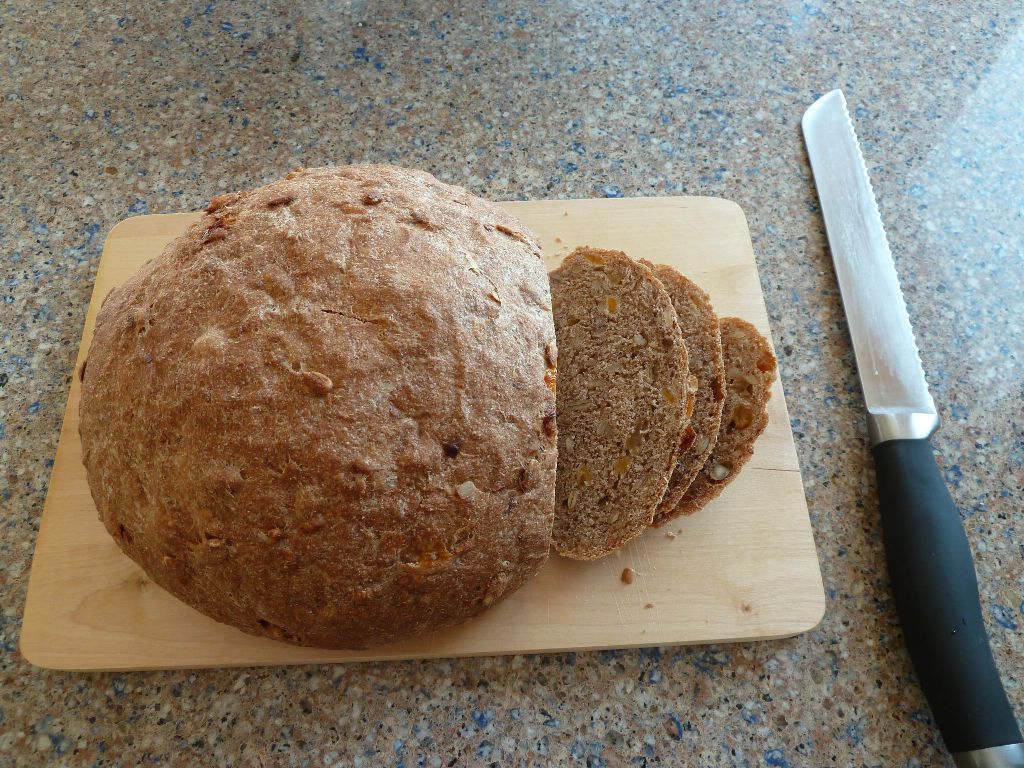
Sliced thin quite nicely

Love the seeds and nuts in the crumb

The bread
The bread sliced thin quite nicely and tasted pretty darn good. I love the taste of the apricot bits in the bread. It was good toasted and spread with strawberry jam. Not a bread for savory sandwiches, but a good hearty snacking bread. It is somewhere between a holiday bread and a plainer seed bread.

Notes
Date: May 19, 2011
Recipe: Transitional German-Style Many Seed Bread from Peter Reinhart's Whole Grain Breads

Flours: Whole wheat flour, rye flour, all purpose flour
Bread specific ingredients: pumpkin seeds, sunflower seeds, walnuts, golden raisins, dried apricots, flaxseeds (vital wheat gluten)
Sweetener used: Table sugar
Liquid: Water

First rise time: 105 minutes, followed by rounding and 30 minutes of resting
Proofing time: 70 minutes
Comments: See description above for measures. Added water and a little oil to get ingredients together. Need to learn more about baking in convection oven. Careful carrying flours through airport security next time. TSA officials might look at them suspiciously and want to put them through additional scanners.

-RPH

Tuesday, April 5, 2011

Potato Rosemary Bread

I was looking for a change from Laurel Robertson's recipes and it came to me when I picked up some fresh rosemary from my in-laws' garden: Reinhart's Potato Rosemary bread. I had made this recipe in the past for a family dinner and it was liked by all.

Starter and biga
Like a typical Reinhart whole-grain recipe, this one also has a biga and starter made a day (or upto 3 days) before baking day. The liquid from boiling the potatoes is used to soak the whole wheat flour for the biga and the starter.

Ingredients for starter and biga

Final dough
On baking day mashed potatoes (boiled the previous day) and fresh rosemary are added to the starter and biga along with more yeast and salt and some olive oil. Optional ingredients are roasted garlic and black pepper and I do plan to make this recipe with garlic at some point.

The usual ingredients + mashed potato and chopped fresh rosemary.

The recipe makes two boules or about 20 dinner rolls. I thought I would try to make one half into a loaf for sandwiches, but the dough was soft enough that it wouldn't have been easy to shape it into a loaf. I believe the potatoes were a tad over boiled and had a higher water content. I should have added more flour but I didn't.

A very soft dough

Ready for the first rise

Well risen after the first (and only) rise

Shaping and proofing
I decided to make a boule with half the dough and shape the rest into dinner rolls. I placed the dinner rolls close enough that they would proof into each other. I kept two of them apart to see if there would be a difference between the ones that stuck to each other and the ones that didn't.

Some dinner rolls and a boule

Proofed with some serious gas bubbles in the boule.

Scored dough. The rolls got four snips each with the tips of the kitchen scissors.

The bread

Out of the oven

Tight moist crumb

The boule sliced well.

Thin crust with some air pockets. Crumb with visible bits of potato.

I used a pan with hot water to generate steam. The rolls were done a little before the boule as expected. They were done in about 35 minutes and the boule took about 50 mins. The two rolls that were not attached to the others didn't get any more oven spring than the ones that were attached. We had some warm rolls with Laughing Cow cheese spread and soup. The combination tasted good. The boule has been frozen for a later time.

Notes
Date: Mar 27, 2011
Recipe: Potato Rosemary Bread from Peter Reinhart's book 'Whole Grain Breads'

Flours: Whole wheat
Bread specific ingredients: Potato, fresh rosemary
Sweetener used: None
Liquid for soaker: Potato water

First rise time: 75 minutes
Proofing time: 45 minutes
Comments: There was too much water in the boiled potatoes, I should have added more flour to make up for it. I should also try the recipe with roasted garlic.

-RPH

Thursday, February 10, 2011

Transitional Rye Sandwich Bread

This bread was the second month bread for my father-in-law's Christmas present. Like the other transitional bread I made that day, this one contained some bread flour, hence the use of 'transitional'.

Soaker and biga
The soaker for this bread contains rye flour and a little whole wheat flour (3:1 ratio). Buttermilk or yogurt are the suggested liquids. I used yogurt thinned down to buttermilk consistency. Unfortunately I forgot to measure the weights of yogurt and water. I added ½ tsp of vital wheat gluten to help with the rise. The biga contains bread flour, tiny amount of instant yeast and some water.

Final dough
Along with the soaker and biga, the final dough contains some more rye flour, salt, instant yeast, molasses, honey, vegetable oil and caraway seeds. I like the taste of caraway seeds in rye breads. Molasses is also often added in rye breads in PR's recipes because they go well together.

Soaker on the left, biga on the right along with other ingredients

Ingredients mixed and ready for kneading

The differently colored soaker and biga are not easy to blend

Shaped and ready for proofing

Decently proofed. This bread did not get slashed

Rye bread in the back. The oven spring is noticeable
along the sides in the absence of slashing on the top

I topped the loaf with just a quick swipe of a butter stick.
It sliced nicely

The crumb. The two different colors have a very nice visual effect.

Notes
Date: Feb 3, 2011
Recipe: Transitional Rye Sandwich Bread from Peter Reinhart's Whole Grain Breads

Flours: Whole wheat flour, rye flour, bread flour
Bread specific ingredients: caraway seeds
Sweetener used: Molasses and honey
Liquid: Thinned yogurt

First rise time: 105 minutes
Proofing time: 75 minutes
Comments: Added ½ tsp vital wheat gluten. Added just a bit of water during the kneading. Kneaded more than usual trying to get the soaker and biga pieces to blend. Not slashing helped in that the dough didn't collapse before putting it in the oven.


-RPH