Or
The disappointing bread-baking continues.
I had bookmarked this recipe in James Beard's 'Beard on Bread' book when I first skimmed through it nearly a year ago. Mostly because it was one of the few recipes that I would probably make. Very very few recipes in this book are over 80% whole grain. This recipe is one of them. It is named for the veteran breadmaker who developed it. The original recipe is not 100% whole grain. Beard provides a variation recipe that is 100% whole grain and it looked reasonable for the most part.
Ingredients
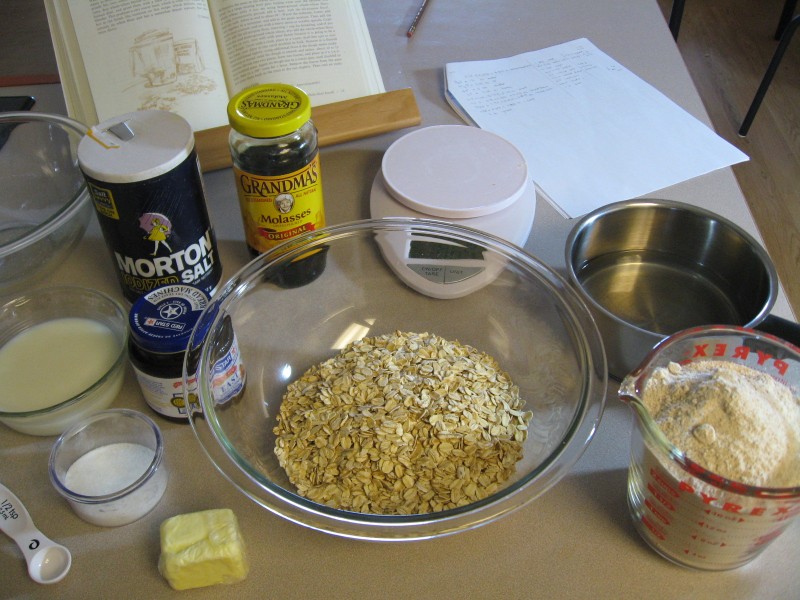
Basically this is a oat and whole wheat bread. I decided to only make half the recipe, for one 9 x 5 pan size loaf. I measured out rolled oats to begin with and at the very last minute switched to quick oats.The recipe calls for 6 tablespoons of molasses per loaf. This seemed unreasonably high, so I used only one tablespoon and added ¼ cup water to make up for the liquid. I also used 1½ tsp instant yeast instead of the 1 package of active dry yeast specified.
The book gives measurements by volume which can become difficult to adjust to when one is used to weights. Sigh! This is how mine ended up:
1½ tsp instant yeast mixed with 142 g warm milk and ½ tsp sugar
200g of boiling water poured over 180 g of quick oats (then cooled to 98º F)
1 tbsp, 11 g butter and 1 tsp salt warmed together
310 g of whole wheat flour measured out, but I didn't use it all.
 |
| Ingredients |
 |
| Partial mixes |
 |
| 1:57 pm: I didn't need all the whole wheat flour |
 |
| 3:28 pm: Decent first rise |
Kneading and rising
The unique thing about this bread was that there isn't much kneading called for before the first rise. After that the dough is kneaded for 10-12 minutes until it is 'smooth and satiny'. Mine was fairly sticky and there wasn't much gluten development. Wet hands made kneading easier, but I wasn't feeling very confident. So I thought I would give it a mini second rise.
 |
| 3:41 pm: Rounded for a mini second rise |
 |
| 3:56 pm: Well risen after 15 minutes |
I decided to bake this in the cast iron combo cooker, even though I have been really wanting a good sandwich bread.
 |
| 3:59 pm: Ready for proofing |
 |
| 4:44 pm: Flattened during proofing |
Baking
I wonder if proofing in a loaf pan as specified in the recipe would have helped with the rise.
 |
| 4:45 pm: In the preheated combo cooker |
I was baking a strawberry cake at the same time that called for 325° F for an hour. This bread called for 350° F for an hour. I thought I could bake at the lower temperature because the combo cooker would do a better job of retaining heat than an open pan.
 |
| Practically no oven spring |
 |
| Sliced well. Soft crust and crumb |
 |
| Super tight crumb |
Notes
Date: July 10, 2011
Recipe: William Melville Child's Health Bread from
James Beard's 'Beard on Bread'
Flours/Grains: Whole wheat, quick oats
Bread specific ingredients:
Sweetener used: Molasses, sugar
Liquid: Water, milk
Comments: I had many small variations from the original recipe and although none of them seemed risky, the combination didn't work. I don't know if I will try this bread again, it didn't have anything special to demand another attempt. If I do it, it will be only to prove that the recipe is good, but I can't imagine adding 6 tablespoons of molasses! The bread does taste good. I've had it with jam, almond butter and soup (separately, of course) and it went well with all three. Some of it might end up as toasted bread crumbs for other recipes.
A picture of the strawberry cake that I made at the same time. The recipe was adapted from two recipes found at
smittenkitchen and
localkitchen.
-RPH